Restaurant operators are facing rising operating expenses, higher food prices, and increasing operational complexity in 2026.
According to the National Restaurant Association, labor costs for full-service restaurants have reached a median of 36.5% of sales, making cost control a top priority for many operators.
A restaurant POS system helps restaurants reduce operating expenses by automating inventory management, payment processing, sales reporting, online ordering, and multi-location operations.
By centralizing these functions in one platform, restaurant owners gain real-time visibility into business performance, reduce manual work, improve customer satisfaction, and make faster business decisions.
Based on abcPOS experience supporting more than 6,000 restaurants, operators that connect their sales, inventory, employees, and customer data through a cloud-based POS system are generally better positioned to control operating expenses and scale efficiently.
This guide will answer the most common questions restaurant owners ask about restaurant POS systems, inventory management, digital transformation, and multi-location operations in 2026.
Restaurant operating expenses are the ongoing costs required to run a restaurant on a daily basis, including:
The key to controlling inventory costs is having real-time visibility into inventory levels and the ability to accurately track inventory throughout daily operations.
Many casual dining and full-service restaurants still rely on manual inventory counts and spreadsheets. This process is time-consuming and often leads to over-ordering, stock shortages, inaccurate purchasing decisions, and food waste.
A cloud-based restaurant POS system automatically connects sales and inventory management data. When an order is placed, the system deducts the required ingredients from inventory in real time.
Benefits include:
In an industry where average profit margins often range between 5% and 10%, reducing food waste by just 2%–3% can have a greater impact on profitability than generating the same percentage increase in sales.
Effective inventory management is not simply an operational task—it is a direct driver of restaurant profitability.
Yes. Many independent restaurant owners assume inventory management software is only necessary for large restaurant chains.
In reality, smaller restaurants are often more vulnerable to inventory loss, purchasing mistakes, and cash flow challenges.
Most POS software already includes built-in inventory management tools, eliminating the need for separate software or expensive hardware investments.
Even a single-location restaurant can benefit from:
Small restaurants often have fewer employees and limited management resources.
A user-friendly POS system helps standardize operations, reduce training time, and provide better visibility into daily performance.
Example:
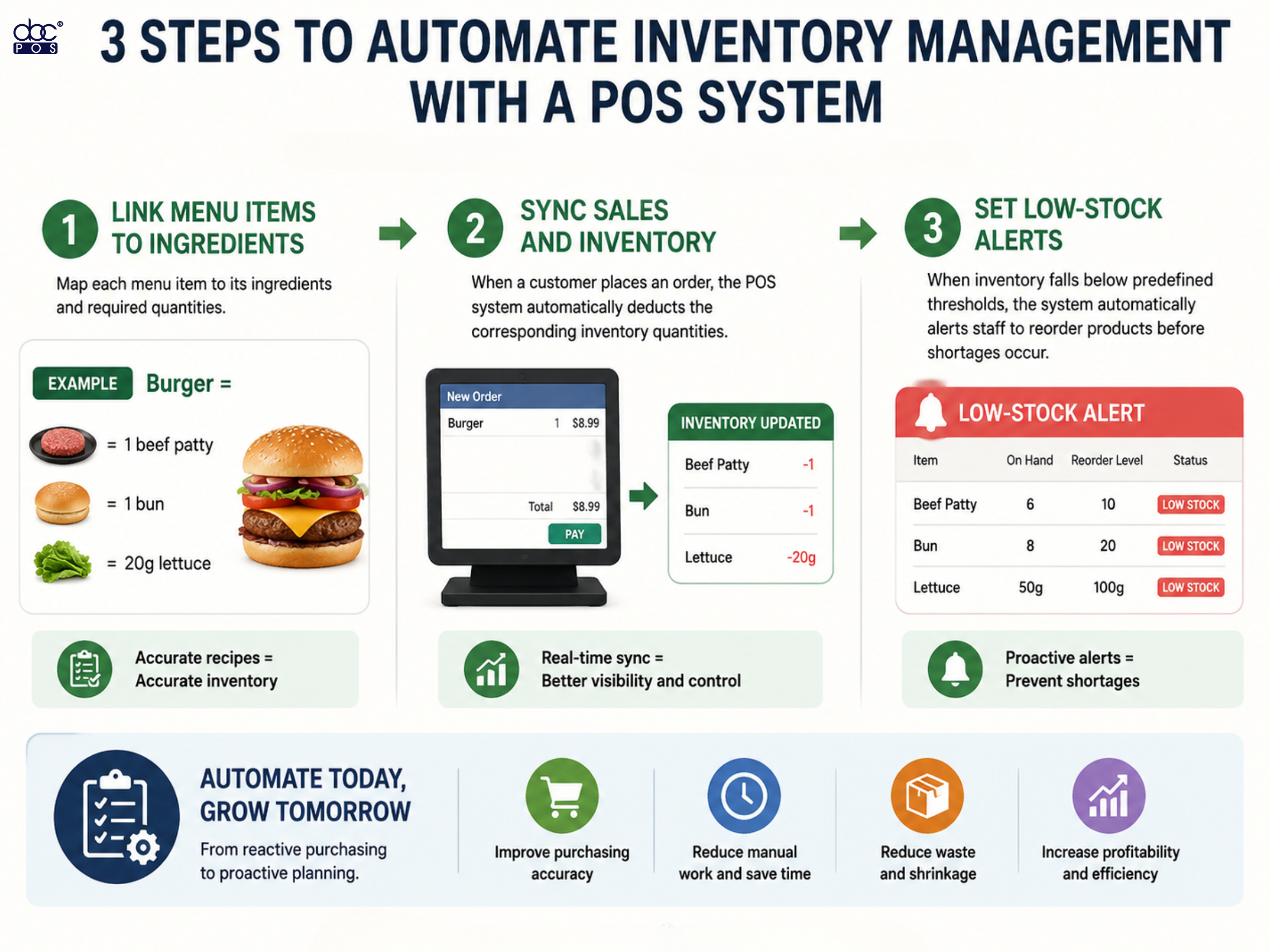
When a customer places an order, the POS system automatically deducts the corresponding inventory quantities.
When inventory falls below predefined thresholds, the system automatically alerts staff to reorder products before shortages occur.
Restaurants that automate inventory tracking move from reactive purchasing to proactive inventory planning, improving purchasing accuracy while reducing unnecessary labor.
For most restaurants, digital transformation should begin with core operational systems.
Recommended implementation order:
The POS system serves as the foundation because it centralizes sales, inventory, employee, and customer data into a single platform.
Based on our 30 years of restaurant technology experience, many digital transformation projects fail not because of budget limitations but because systems are implemented in the wrong order.
Building a strong POS foundation first creates the operational framework necessary for long-term growth.
Before expanding, restaurant owners should establish a centralized management platform.
Without a unified system, it becomes difficult to monitor:
A centralized platform also provides detailed sales reporting, allowing owners to compare performance across stores and make more informed business decisions.
One of the biggest challenges in multi-location operations is maintaining consistency across locations.
Multi-location management capabilities should be implemented before opening a second restaurant, not after operational challenges begin to appear.
Yes.
Today's Restaurant point of sale systems have evolved far beyond traditional cash registers.
it combines:
A POS system can manage everything from payment processing and customer transactions to inventory control and business analytics within a single system.
Many restaurant owners view technology primarily as an operational tool, but it also plays a significant role in improving customer satisfaction.
A modern POS system helps restaurants:
When employees spend less time on manual tasks and administrative work, they can focus more on guest experiences.
Better service often leads to higher customer satisfaction, stronger retention, and increased repeat business.
A restaurant POS system centralizes sales, inventory management, payment processing, and reporting into one platform, helping operators reduce costs and improve efficiency.
Yes. Modern POS systems automatically deduct inventory when items are sold and can generate low-stock alerts when products need to be reordered.
For most restaurants, abcPOS Restaurant POS system provide real-time reporting, remote access, inventory management, and multi-location capabilities that traditional cash registers cannot offer.
Yes. Many abcPOS Restaurant POS system include multi-location management features that allow owners to monitor sales, inventory, employees, and reporting across all locations from a single dashboard.
By streamlining order entry, payment processing, inventory tracking, and table management, POS systems help staff serve guests more efficiently and accurately.
In 2026, a restaurant POS system is no longer just a cash register.
it helps reduce costs and improve operations by centralizing inventory management, payment processing, online ordering, employee management, and sales reporting into one platform.
This gives restaurant operators better visibility, reduces manual work, improves efficiency, and supports profitable growth.
Fill out the form below to receive:
Product demo videos/live Demo and see pricing


Copyright © 2024
A registered ISO of Wells Fargo Bank, N.A., Concord, CA
Abacus Business Computer


