Restaurant labor costs in the U.S. have increased significantly since 2020, while staff turnover remains high across the industry.
Many restaurant owners initially try to solve the problem by hiring more employees or cutting labor hours. But during peak hours, operations still become chaotic, wait times increase, and customer experience suffers.
More restaurants are realizing that the real problem is not simply labor shortages.
It’s operational efficiency.
In many restaurants, servers still spend most of their time:
This becomes even more challenging for restaurants with complex menus, especially hot pot, BBQ, ramen, bubble tea, and AYCE concepts.
Customers frequently ask about:
When this happens table after table, ordering becomes one of the biggest bottlenecks in restaurant operations.
In fact, many busy restaurants don’t struggle because the kitchen is slow.
They struggle because the ordering process is too slow.
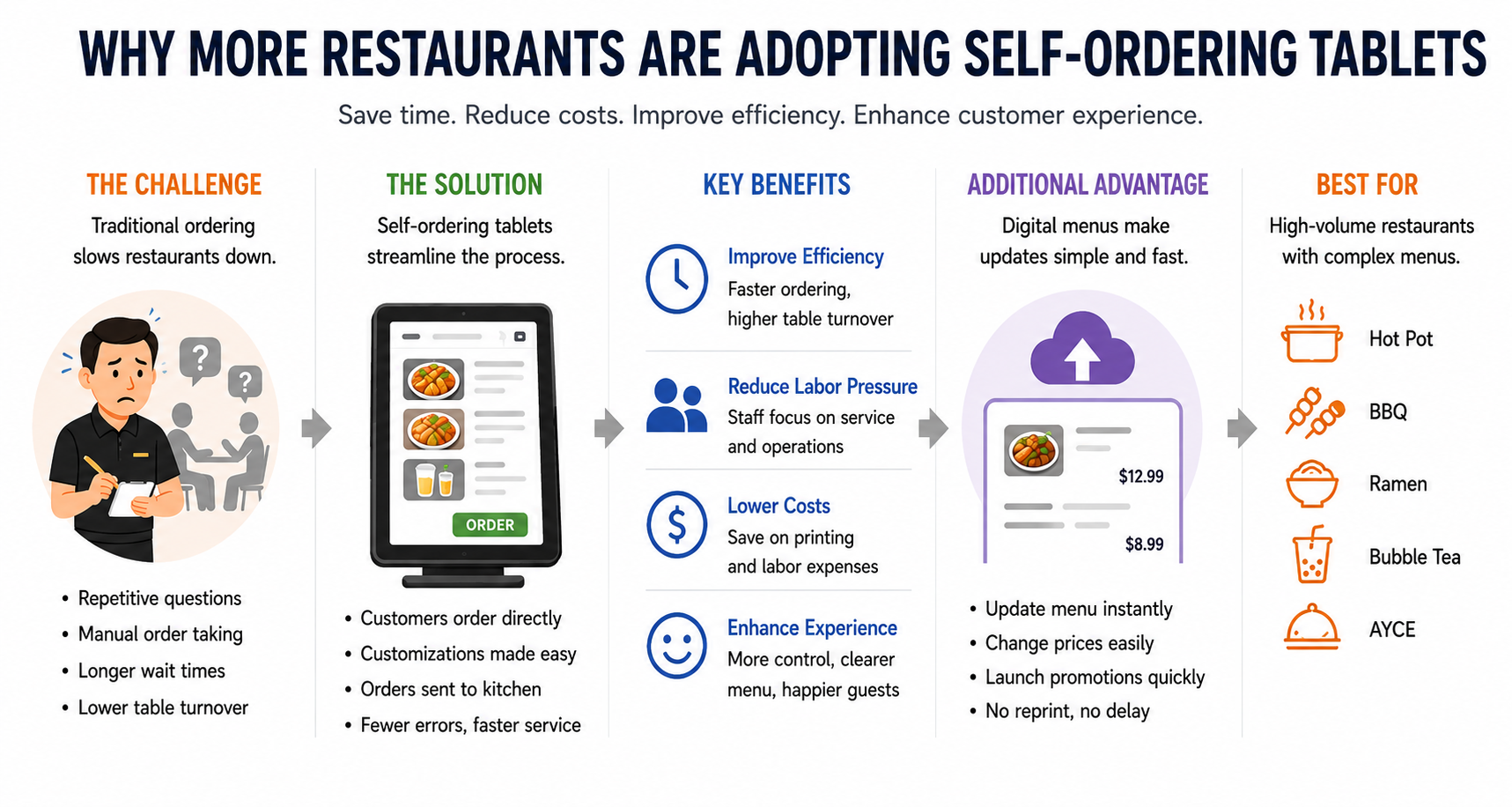
Self-ordering tablets help reduce repetitive communication during the ordering process.
Instead of waiting for staff assistance, customers can immediately:
This reduces confusion, speeds up ordering, and minimizes human error.
Orders are automatically sent to the kitchen system, allowing staff to focus on more valuable tasks like customer service, food delivery, and floor management.
For many restaurants, the goal is not replacing employees.
It’s using employee time more efficiently.
Many restaurant owners underestimate how much ordering speed affects table turnover.
During peak hours, even a small delay at each table creates longer wait times throughout the restaurant.
If customers spend:
That delay compounds across the entire dining room.
Many restaurants report that shortening the ordering process by just a few minutes per table can noticeably improve peak-hour efficiency and guest flow.
Another overlooked challenge for restaurants is menu updates.
According to the National Restaurant Association, over 90% of restaurants adjusted menu prices within the past two years due to rising food costs.
With traditional paper menus, every change requires:
Digital menus eliminate most of that process.
Restaurants can instantly update:
For restaurants that frequently adjust menus, this flexibility becomes a major operational advantage.
Self-ordering systems are especially effective for:
Common examples include:
However, self-ordering is not ideal for every concept.
Fine dining restaurants that prioritize personalized hospitality may still benefit more from traditional table service.
Self-ordering technology is not really about removing people from restaurants.
It’s about reducing repetitive tasks so staff can focus on creating a better customer experience.
As labor costs continue rising, more restaurants are shifting their focus toward operational efficiency.
The growing adoption of self-ordering tablets reflects a larger change happening across the restaurant industry: finding better ways to balance speed, labor, and customer experience.
No. Most restaurants use self-ordering systems to reduce repetitive tasks and improve efficiency, not eliminate employees. Staff can spend more time on customer service and restaurant operations.
Yes. Faster ordering usually helps restaurants reduce wait times and improve guest flow during peak hours.
Most modern systems are designed to be simple and visual. Customers can easily browse photos, customize orders, and place orders directly from the screen.
Restaurants with high traffic, complex menus, and busy peak hours typically see the biggest benefits. This includes hot pot, ramen, BBQ, bubble tea, and AYCE restaurants.
For restaurants that frequently update prices or promotions, digital menus are far more flexible and cost-effective than traditional printed menus.
Fill out the form below to receive:
Product demo videos/live Demo and see pricing


Copyright © 2024
A registered ISO of Wells Fargo Bank, N.A., Concord, CA
Abacus Business Computer


