A restaurant can serve excellent food, offer an attractive atmosphere, and provide good service—yet still lose potential customers before they ever walk through the door.
The reason is simple. When consumers search for phrases such as “restaurants near me,” “best sushi nearby,” or “Chinese restaurant near me,” they often see star ratings, review counts, and recent customer feedback on Google Search and Google Maps before deciding whether to visit the restaurant’s website, view its menu, make a reservation, or request directions.
According to the official Google Business Profile guidelines, local search results are primarily determined by three factors:
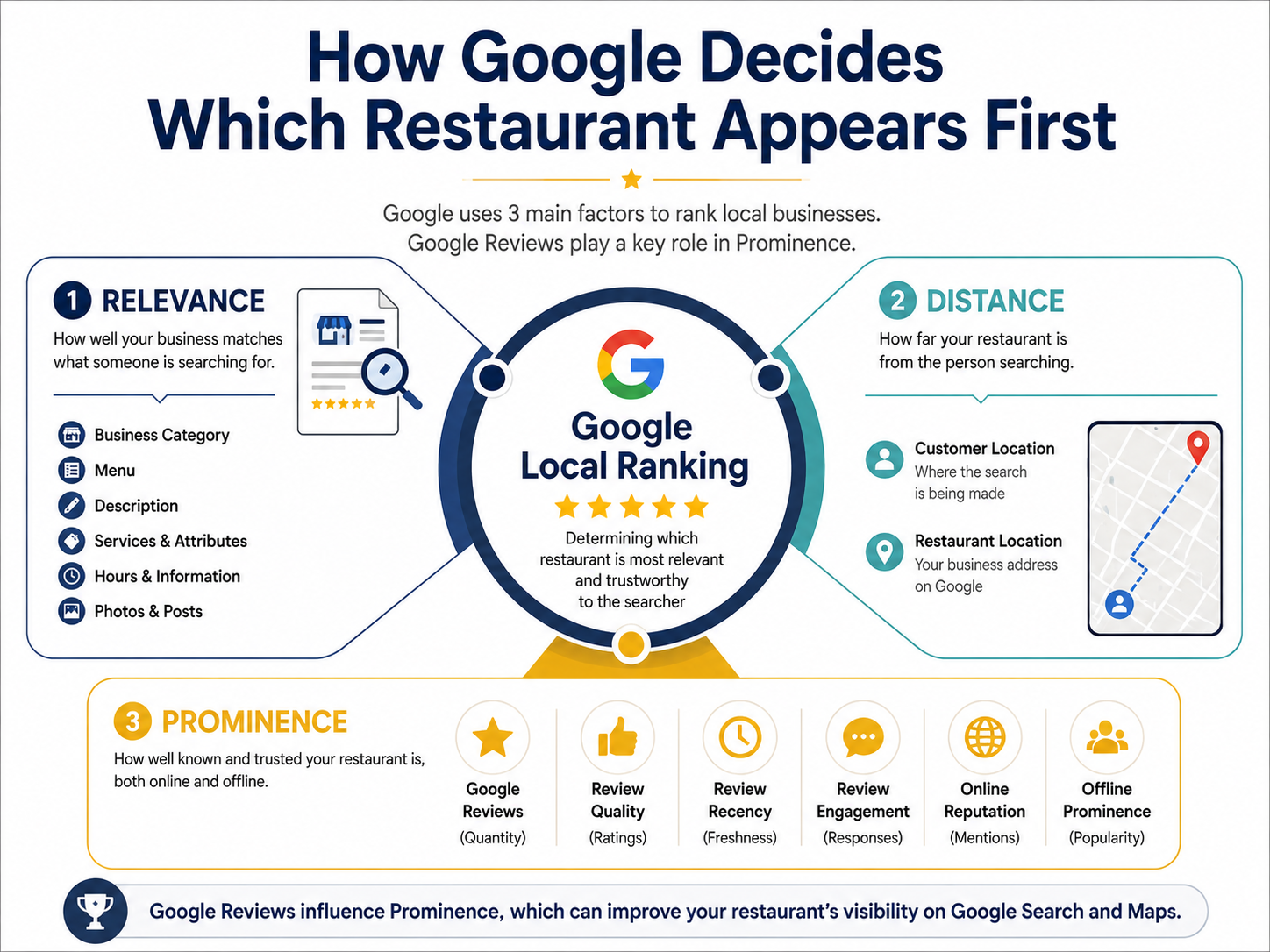
Google also states that review count and positive ratings can affect local search rankings. Google Reviews are therefore more than a display of customer opinions. They are an important part of a restaurant’s local visibility, consumer trust, and revenue conversion journey.
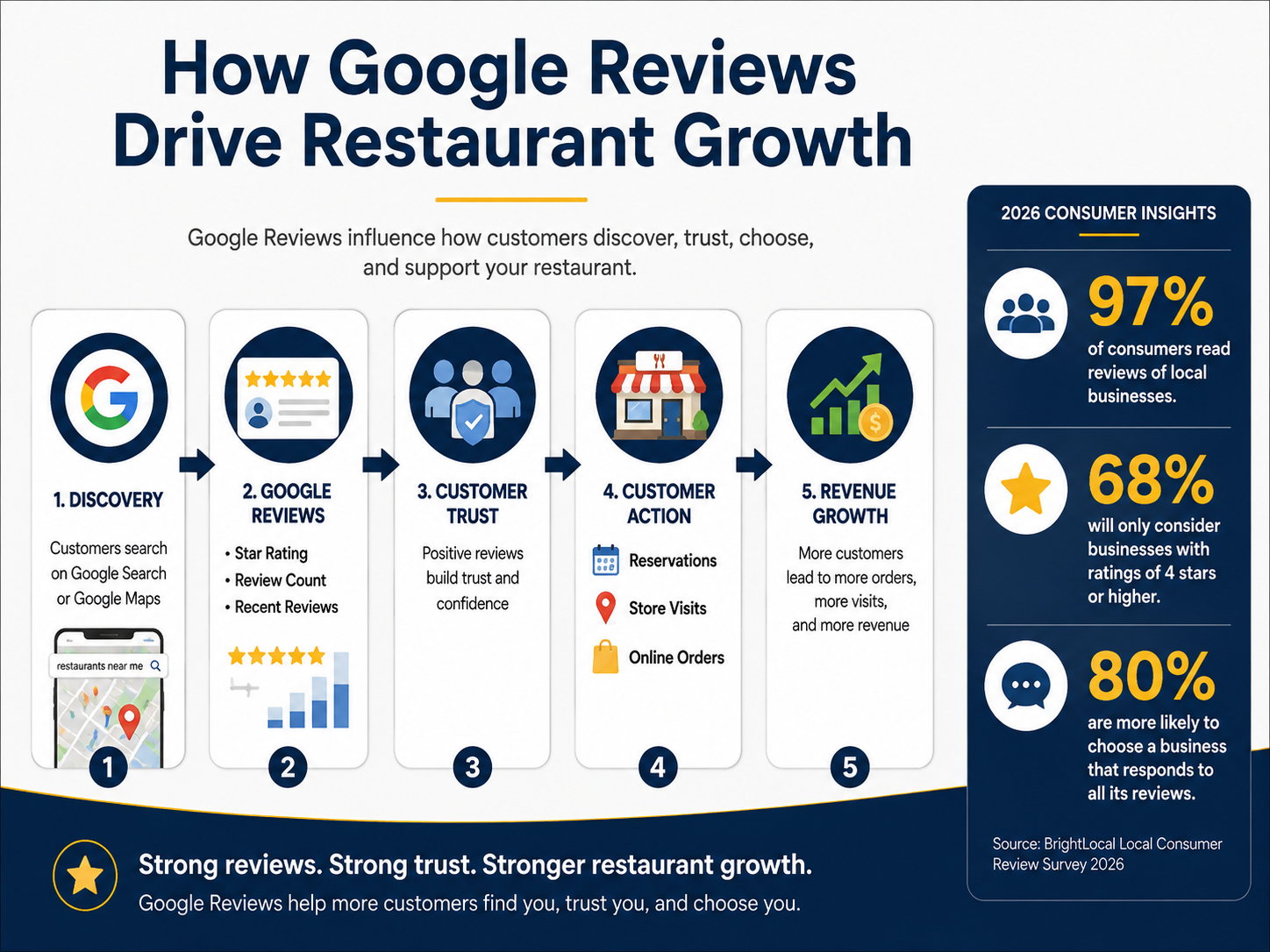
The BrightLocal Local Consumer Review Survey 2026, based on a survey of 1,002 U.S. adults, found that:
This means that in 2026, a restaurant with few recent reviews, a low rating, or no owner responses may be eliminated from consideration before a potential customer even sees its menu.
The value of Google Reviews for restaurants can be summarized in three areas: improving local search visibility, building consumer trust, and generating more reservations, visits, and orders.
When consumers search for nearby restaurants, Google must determine which businesses are relevant and which ones deserve prominent placement.
A complete Google Business Profile helps Google understand a restaurant’s category, address, hours, and services. A steady flow of authentic customer reviews provides additional signals that the business is active and established.
Restaurants with more reviews, consistently strong ratings, and recent customer feedback may have a better opportunity to attract attention for high-intent searches such as:
Reviews are not the only local ranking factor, and restaurants cannot purchase or request a guaranteed position in Google’s local results. Distance, business category, profile completeness, website content, and local prominence all contribute to ranking.
However, when two restaurants have similar relevance and proximity, an authentic and consistently updated review profile can help one restaurant build a stronger local presence.
In short: The more authentic, consistent, and recent a restaurant’s reviews are, the greater its opportunity to earn organic visibility on Google Search and Google Maps.
Consumers cannot judge an actual dining experience from the restaurant’s advertising alone. Instead, they look for patterns across multiple customer reviews.
BrightLocal’s 2026 survey found that consumers consider more than the average star rating. They also evaluate:
This explains why a restaurant with a 4.5-star rating but no new reviews for six months may create a different impression from one with a 4.4-star rating and authentic new feedback every week.
The second restaurant may provide stronger evidence that it is actively operating and that its current customer experience remains reliable.
Restaurant reviews also cover much more than food. Customers frequently mention:
Google Reviews therefore reflect the entire customer journey—not just the quality of an individual dish.
In short: Google Reviews have become one of the first digital trust barriers a restaurant must overcome before a customer is willing to try it.
Positive reviews do not automatically turn into revenue, but they can influence whether a customer moves from consideration to action.
BrightLocal’s 2026 data shows that 85% of surveyed consumers are more likely to choose a business after reading positive reviews. Meanwhile, 34% may be ready to make a purchase or booking, while many others continue by visiting the business’s website, checking its social media profiles, or reading additional reviews.
Reviews therefore serve two important purposes:
The Harvard Business School study Reviews, Reputation, and Revenue also found that, within its sample of Yelp ratings and independent U.S. restaurants, a one-star rating increase was associated with an approximately 5%–9% increase in revenue.
This research examined a particular market, time period, and review platform. It should not be interpreted to mean that every restaurant will increase revenue by 5%–9% whenever its Google rating rises by one star.
Nevertheless, the study offers an important operational insight: when consumers have limited information, public reviews can influence restaurant demand, with independent restaurants potentially experiencing an especially meaningful effect.
Google has not published a fixed number of reviews required to achieve a higher local ranking. Targets such as 50, 100, or 300 reviews are better treated as internal benchmarks—not official Google ranking thresholds.
Comparing your restaurant with its local competitors is more useful than pursuing an arbitrary total.
Search for your restaurant’s primary keywords and examine the five to ten highest-ranking local competitors. Record:
If the leading restaurants in your area generally have more than 200 reviews while your restaurant has only 20, your initial goal may be to begin closing that gap.
If competitors have hundreds of reviews but have received no new feedback in six months, consistently earning new reviews could become a meaningful point of differentiation.
A reliable restaurant review strategy should monitor four metrics:
Satisfied customers often consider a smooth dining experience normal, so they may feel little motivation to write about it. Customers who encounter a significant problem are usually more motivated to share their frustration.
If a restaurant waits passively for reviews, its online reputation may overrepresent a small number of negative experiences rather than accurately reflecting its normal level of service.
The solution is not to purchase reviews, offer rewards in exchange for five-star ratings, or invite only satisfied customers to post feedback.
A more sustainable approach is to give every genuine customer the same unbiased opportunity to share an honest review after their visit.
Google provides an official method for creating review links and QR codes. Restaurants can place these review invitations on:
Suggested wording:
Thank you for dining with us. Your honest feedback helps us improve our food and service while helping other customers make informed decisions. We invite you to share your experience on Google.
Avoid language such as “Please give us a five-star review.” Restaurants should also avoid offering discounts, free products, or sweepstakes entries in exchange for positive feedback.
BrightLocal’s 2026 survey found that 80% of consumers are more likely to choose businesses that respond to all their reviews. At the same time, 50% may be discouraged by generic or repetitive responses.
An effective review response should be timely, specific, and sincere.
Thank the customer and acknowledge the particular food, employee, or experience mentioned in the review.
Example:
Thank you for your kind comments about our handmade dumplings and lunch service. We also appreciate you recognizing our front-of-house team. We will be happy to share your feedback with everyone, and we look forward to welcoming you again.
Begin by acknowledging the customer’s experience. Explain that the restaurant will investigate the issue, and move conversations involving orders, refunds, or personal information to a private channel.
Example:
We are sorry that the wait and food preparation times did not meet expectations during your visit. We are reviewing that day’s staffing and order workflow and would appreciate the opportunity to learn more about when you visited. Please contact our manager through the information on our website so we can follow up properly.
The goal is not to “win” a public argument. It is to show both the reviewer and future customers that the restaurant listens and takes responsibility.
Reviewing customer feedback by theme each month can reveal issues that may not appear in menu reports or standard operating data.
Consider organizing reviews into the following categories:
Record the number of positive and negative mentions for each category. Compare trends across the past 30 days, 90 days, and previous quarter.
If customers repeatedly mention long waits, the restaurant may need to review staffing, kitchen capacity, or its approach to accepting orders during peak hours.
If a particular dish receives frequent praise, consider highlighting it on the menu, website, and Google Business Profile.
Reviews are therefore not only marketing assets. They are also a continuously updated source of customer-experience data.
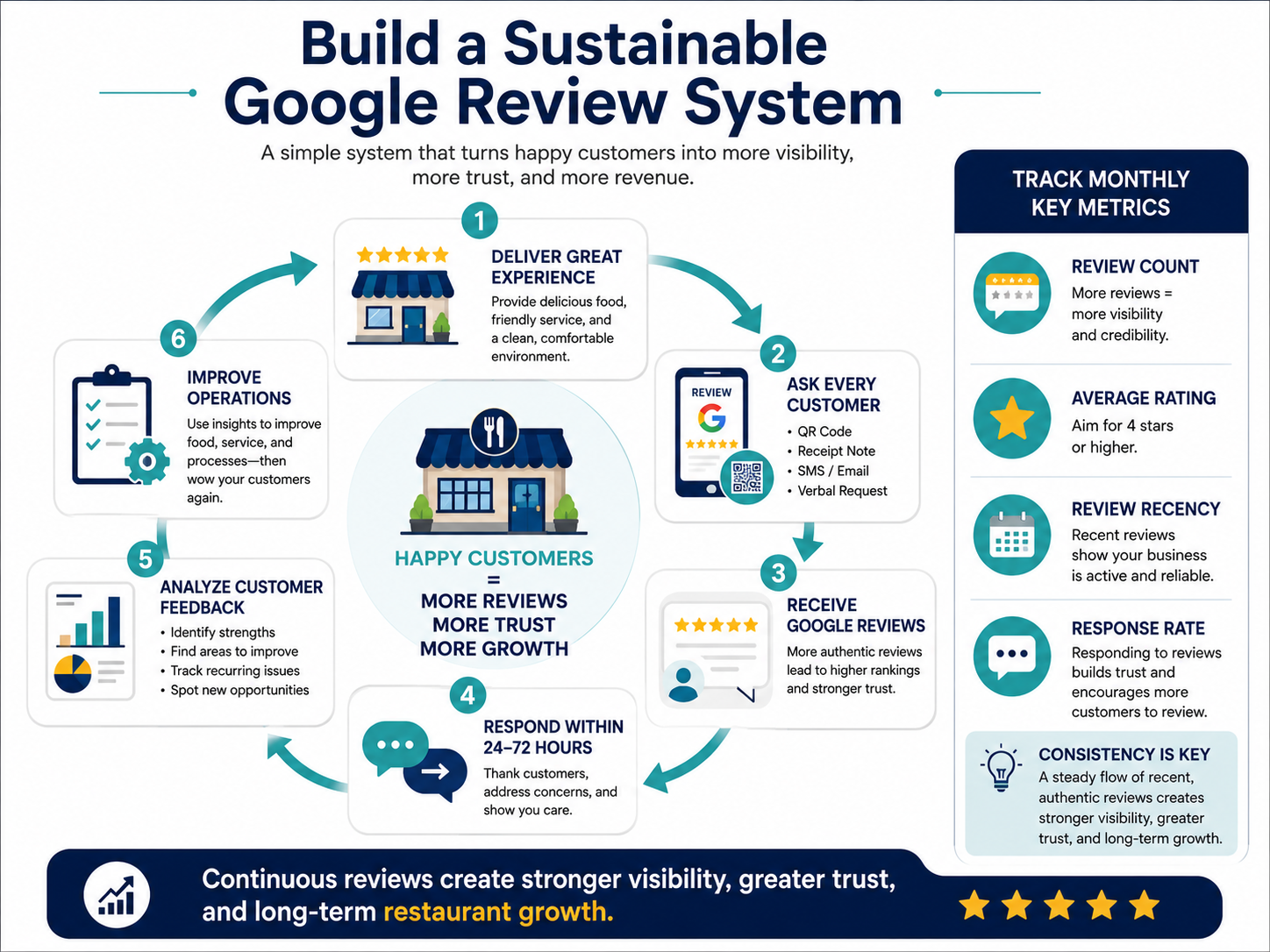
Restaurants can begin with the following steps:
Yes, but reviews are not the only factor. Google states that local results are primarily based on relevance, distance, and prominence. Review count and positive ratings contribute to prominence.
There is no universal rating that applies to every market. In BrightLocal’s 2026 survey, 68% of U.S. respondents said they would only consider businesses rated four stars or higher, while 31% would only consider businesses rated 4.5 stars or higher.
Restaurants should also evaluate the competitive standards for their city, cuisine, neighborhood, and price range.
Google does not prescribe a fixed frequency. The goal should be to invite genuine customer feedback consistently and naturally—not to go several months without a review and then generate an unusual surge.
Restaurants should respond to as many legitimate reviews as possible. Consumers observe not only how a restaurant handles complaints but also whether it appreciates satisfied customers.
Responses should be specific and should not repeatedly use identical templates.
Reviews influence search visibility, consumer trust, and purchasing behavior, so they may affect orders both directly and indirectly.
Actual revenue results also depend on location, menu, pricing, service, competition, and the restaurant’s conversion process. No fixed increase can be guaranteed.
In 2026, Google Reviews are no longer simply an online collection of customer opinions.
They influence whether a restaurant can be discovered through Google Search and Google Maps, whether a potential customer feels confident visiting for the first time, and whether the restaurant can identify opportunities to improve its food, service, and operations.
The most effective strategy is not to chase a large number of five-star reviews in a short period. It is to build a sustainable system: deliver a consistently good experience, invite every genuine customer to provide honest feedback, respond thoughtfully, and turn recurring review themes into operational improvements.
The importance of Google Reviews for restaurants can ultimately be summarized in one sentence:
Google Reviews help restaurants improve local search visibility, build consumer trust, and generate more orders and long-term revenue.
Author: Jason Han
Last updated: August 3, 2026
Scope: This article primarily relies on U.S. consumer research and official Google documentation. Consumer behavior may differ in other countries and cities.
Fill out the form below to receive:
Product demo videos/live Demo and see pricing


Copyright © 2024
A registered ISO of Wells Fargo Bank, N.A., Concord, CA
Abacus Business Computer


