Author: Ivy Z (10+ years experience integrating restaurant POS, online ordering, and delivery platforms across North America)
Restaurants today operate across multiple channels—dine-in, takeout, delivery apps, and direct online ordering—while facing rising labor costs and operational complexity. An all in one POS system consolidates these workflows into a single platform, helping restaurant owners simplify operations, improve accuracy, and increase profitability.
This page is a comprehensive guide to all-in-one restaurant POS systems, how they work, and why they provide solutions.
An all in one restaurant POS system is a unified platform that manages ordering, payments, kitchen operations, inventory, staff permissions, and reporting in one system, eliminating the need for multiple disconnected tools and devices.
Unlike traditional POS setups that require separate tablets, printers, and software platforms, an integrated POS centralizes all restaurant operations in a single dashboard.
Modern restaurants receive orders from:
An all-in-one POS aggregates all orders into one interface, reducing missed orders and manual entry errors.
Manual order routing and data entry require extra staff time. Automated workflows reduce front-of-house and kitchen staff movement, allowing teams to focus on guest experience and upselling.
Automated order routing and centralized menus reduce miscommunication between staff and kitchen teams, lowering refund rates and negative reviews.
Advanced POS analytics provide insights into:
These insights help restaurant owners optimize menus, staffing schedules, and pricing strategies.
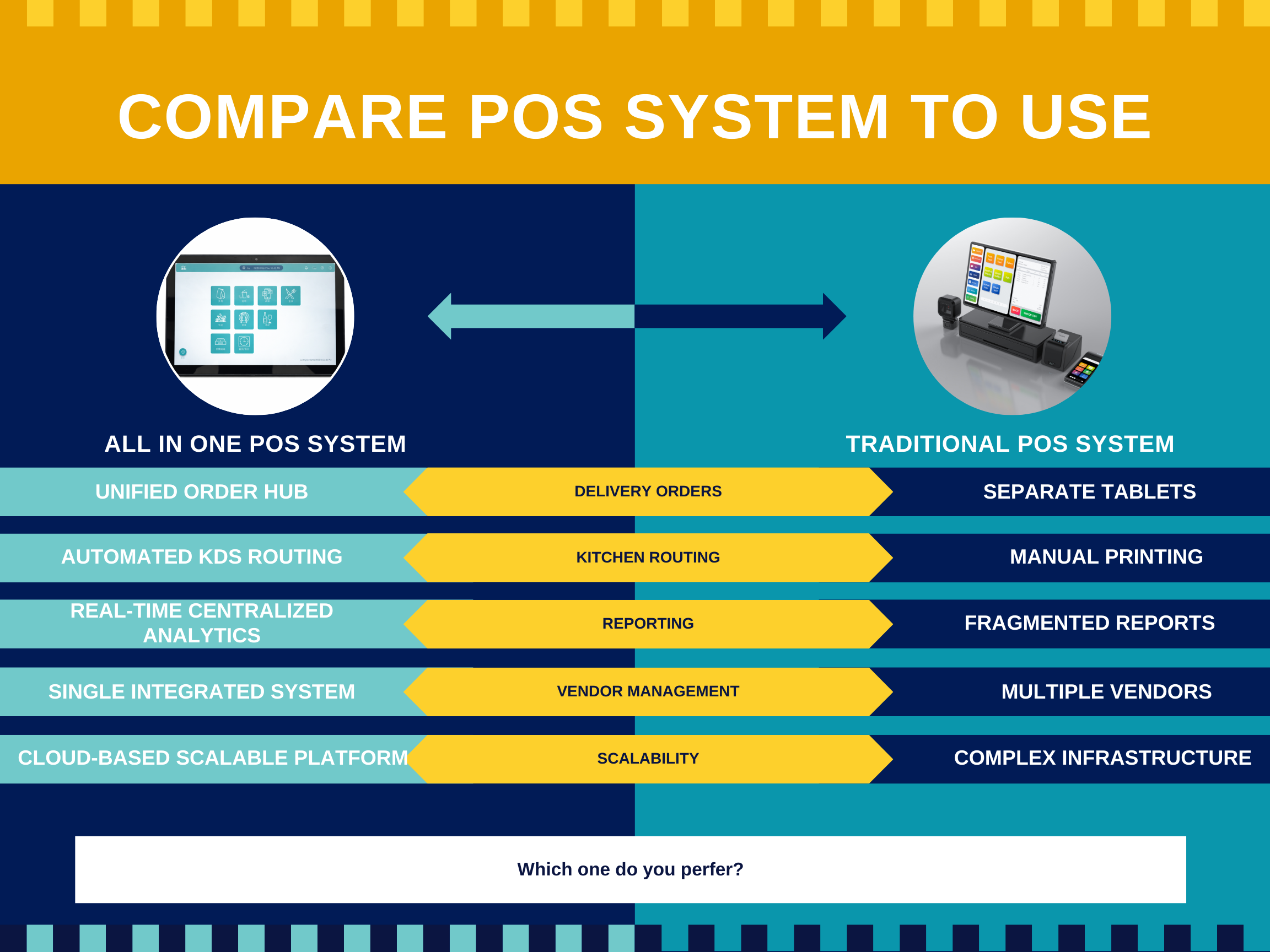
Manage dine-in, takeout, delivery, and online orders from one system—no more multiple tablets.
Orders are automatically routed to the correct preparation station (grill, bar, dessert, etc.), improving kitchen speed and coordination.
Update menus once and sync across all channels. Inventory tracking reduces food waste and prevents stockouts.
Dashboards for:
Support for modern payment methods with PCI-compliant security standards to protect sensitive customer data.
Automation reduces repetitive manual tasks, allowing managers to focus on growth and guest experience.
Faster order processing and fewer mistakes lead to higher customer satisfaction and repeat business.
Cloud-based POS systems make it easy to add locations, menus, and ordering channels without complex IT infrastructure.
Restaurant groups can manage menus, pricing, staff permissions, and reporting across all locations from a single dashboard.
An all-in-one POS system is no longer just a technology upgrade—it is a strategic investment in operational efficiency, scalability, and profitability. By consolidating ordering, payments, kitchen workflows, inventory, and analytics into one platform, restaurants can reduce complexity, improve accuracy, and make data-driven decisions that directly impact revenue.
2.POS systems for different types of restaurants.
3.How to choose the right POS system products to solve specific problems?
4.Which major pain points can the right POS system solve?
5.Knowledge and Information on the Restaurant Industry
Yes. Small restaurants benefit from simplified operations, fewer devices, and better visibility into sales and costs.
Most modern systems support third-party delivery integrations. ABCPOS consolidates delivery orders into one unified workflow.
Pricing varies by features, hardware, and number of locations. Many providers offer subscription-based pricing with scalable plans.
Cloud POS systems offer real-time updates, remote management, and easier scalability compared to on-premise legacy systems.
Fill out the form below to receive:
Product demo videos/live Demo and see pricing


Copyright © 2024
A registered ISO of Wells Fargo Bank, N.A., Concord, CA
Abacus Business Computer


