Most restaurant owners do not replace their POS systems because they want more features. They switch because they are frustrated with poor customer support, hidden contracts, unstable systems, unreasonable high payment processing fees, and operational problems that directly affect their business every day.
According to the National Restaurant Association, restaurant operators continue prioritizing operational efficiency and technology reliability as labor costs and customer expectations increase. That is why choosing the right restaurant POS system requires more than comparing features or promotional pricing.
This guide explains what actually matters before buying a restaurant POS system based on real operational frustrations commonly experienced by restaurant owners after deployment.
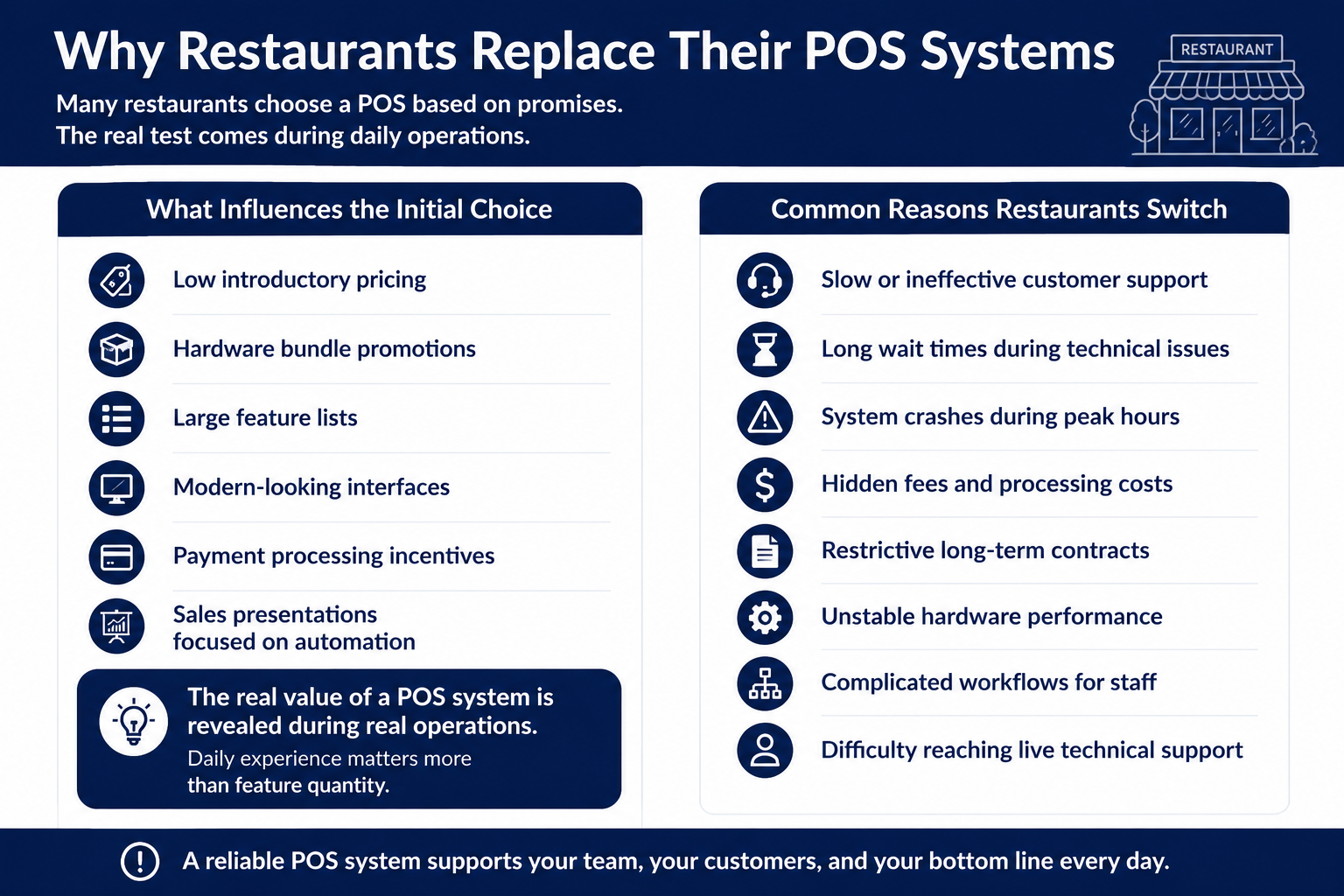
Many restaurant owners initially choose a POS provider based on:
However, the true value of a restaurant POS system is usually revealed during real restaurant operations.
Many operators discover that daily operational experience matters far more than feature quantity.
Common reasons restaurants replace their POS systems include:
One restaurant operator reported spending more than four hours during dinner service attempting to resolve a payment terminal issue while employees manually processed orders to keep operations running. Another described payroll synchronization problems that forced management to manually verify employee hours for multiple pay periods.
Some restaurant owners describe situations where simple printer failures or kitchen display issues took hours to resolve while staff attempted to continue service manually.
For restaurants, downtime is expensive.
Even short operational interruptions can lead to:
Many restaurant POS providers invest heavily in customer acquisition but underinvest in long-term support infrastructure. However, restaurant operators do not judge POS systems by the sales process alone. They judge them by how quickly problems are solved when operations are under pressure. Great restaurant POS companies provide fast, knowledgeable, human support that understands real restaurant workflows.
Before signing any restaurant POS agreement, operators should ask practical operational questions that directly affect long-term performance.
Another major frustration restaurant owners frequently mention is restrictive long-term contracts.
Before signing any restaurant POS agreement, owners should carefully review:
Restaurants need fast access to knowledgeable support teams during real operating hours.
Software stability matters more than excessive features that rarely improve day-to-day operations.
Restaurant owners should clearly understand fees, processing rates, contract terms, and hardware costs upfront.
Simple systems reduce onboarding time and improve employee efficiency.
POS providers should retain customers through strong performance — not restrictive agreements.
The system should simplify order flow, kitchen communication, reporting, and employee management.
Restaurants should focus on support quality, ease of use, pricing transparency, and overall reliability instead of choosing based only on features.
Common reasons include slow support, unstable systems, hidden costs, complicated workflows, and high processing fees.
Yes. System interruptions during busy hours can slow operations, delay orders, and negatively impact customer experience.
Not necessarily, but restaurant owners should carefully review cancellation terms, renewal clauses, and processing agreements before signing.
Instead of focusing only on demos or promotions, restaurants should evaluate real-world performance, support responsiveness, and long-term operating costs.
Jason H works with restaurant operators and hospitality businesses at abcPOS, helping restaurants improve operations through POS technology, payment systems, workflow optimization, and restaurant management solutions.
His work focuses on helping restaurant owners simplify operations, improve service efficiency, and reduce operational friction through practical restaurant technology solutions tailored to real restaurant environments.
Fill out the form below to receive:
Product demo videos/live Demo and see pricing


Copyright © 2024
A registered ISO of Wells Fargo Bank, N.A., Concord, CA
Abacus Business Computer


